Showing posts with label Immigrant. Show all posts

Wednesday, October 11, 2017

John Peter Keller I 1708-1803


Heather's 8th great paternal grandfather

John Peter Keller
Son of
Born abt 1708 in Switzerland
Died between 1791 & 1803
Married
Anna Maria
Daughter of
Born
Died


Children:
Carl Andrew Keller 1750-1803 m. Barbara Judith Bigler
Johan Adam Keller
Mary Keller m. Edward Powell
Christina Keller M. Frederick Daughterman


Peter's will (included near the bottom of this post) mentions sons Andrew & Adam, with Andrew receiving the homestead.  It also mentions daughter Mary wife of Edward Powell, and daughter Christina, wife of Frederick Daughterman, deceased.  In addition, it lists grandchildren Mary, Jacob, Susanna, & Elizabeth Daughterman.

Occupation - Brass Founder & Rope Maker


Title : Pennsylvania Genealogies : Index of Surnames

Source Information
Ancestry.com. North America, Family Histories, 1500-2000 [database on-line]. Provo, UT, USA: Ancestry.com Operations, Inc., 2016.

1735 - Immigrated from Switzerland

Lancaster, Pennsylvania, Mennonite Vital Records, 1750-2014

Or is this record correct?
Name: John Peter Keller
Birth Year: abt 1713
Arrival Year: 1748
Arrival Place: Pennsylvania
Age: 35
Source Publication Code: 1804
Primary Immigrant: Keller, John Peter

Annotation: Taken from original manuscripts in the state archives. Names given throughout pages 1-677. Foreigners arriving in Pennsylvania named on pages 521-667. No. 3776, Kelker, supplements this.


  1. Media: Digital Book
    Abbrev: Pennsylvania Genealogies
    Title: Pennsylvania Genealogies Chiefly Scotch-Irish and German
    Author: Egle, William Henry, M. D., M. A.
    Publication: Clearfield
    Date: 27 Jun 2008
    Repository:
      Name: Ancestry
      Page: p. 341
    Quality: 3
    Date: 27 Jun 2008
    Text: Johann Peter KELLER, a native of Germany, emigrated to Amer ica prior to 1760, and settled in Lancaster county, Pennsyl vania where he died; his wife Anna Maria, b. in Germany, di ed in the town of Lancaster on 6 January 1782. They had tw o children b. in Germany:
    1. Carl Andrew, b. 14 July 1750
    2. Johann Adam

Daughter Mary Keller is Born
Abbrev: Peter Powell Family of Lancaster County, Pennsylvania
Title: Peter Powell Family of Lancaster County, Pennsylvania
Author: Stauffer, Romaine
Publication: 27 jun 2008
Date: 27 Jun 2008
Text: Edward Powell and Mary Kehler/Keller were married Jan. 5, 1 771 at St. Paul's Protestant Episcopal Church in Philadelphia, Pa. She was the daughter of German immigrant Peter and Anna Maria Kehler/Keller.


Between 1791 - 1803 - John Peter Keller died

His memorial stone says 1782, same as the record in Lancaster, Pennsylvania, Mennonite Vital Records, 1750-2014.  Note that on that record, the date of death has a question mark.  His will however, was written in 1791, and proved in 1803.  

Burial:

Unknown.

Find a Grave Entry:

Birth: 1708, Switzerland
Death: 1782
Lancaster County
Pennsylvania, USA

John Peter Keller I immigrated from Switzerland in about 1748. Although he was probably buried in Lancaster County, PA, a memorial stone was placed in Harrisburg Cemetery where many members of his family are buried, including John Peter Keller II, III, IV and V. 


Memorial Stone:


Inscription:

JOHN PETER KELLER
1708--1782
BORN IN SWITZERLAND
BURIED AT LANCASTER, PA

Research:
"CHARLES B KELLER recorder of deed_s for Lancaster county lives in an elegant suburban home built on land that has been in the possession of the Keller family for generations land that was secured from the Penns by Mr Keller s greatgrandfather At first this tract comprised but five acres but Mr Keller acquired more land until he held eighty six acres The founder of the Keller family in America was Johann Peter Keller a native of Germany who came to these shores prior to 1760 settling in Lancaster county where he died, His wife Anna Maria born in Germany died in Lancaster Jan 6 1782 Two of their children Carl Andrew and Johann Adam were born in Germany,

 Carl A Keller son of Johann Peter married Barbara Judith Bigler and from this couple Charles B Keller is descended.

 John Andrew Keller son of Carl A and father of Charles B married Harriet Trissler and both passed their lives in Lancaster He died in 1856 They had the following children Samuel Benjamin Schaeffer Villiam Augustus Clara John Adam Lizzie Kate Harriet Maria Ella Emanuel and Charles B Charles B Keller was born Oct 20 1853 next door to the courthouse in East King street where his father then lived He was graduated from the Boys High School in 1868 with valedictory honors and graduated from Muhlenberg College in 1873 After being associated with his brother Villiam A in the manufacture of paper boxes in Philadelphia for a year Mr Keller became principal of the Strasburgr schools in 1874 remaining there ten years and raising the standard of the schools to a high grade During his stay in that town he graduated hundreds of young people and is held in grateful memory in that community In 1884 Mr Keller became engaged in the coal and lumber business at Ephrata where he remained ten years He was early identified with the Independent Telephone company an organization that gave to the people of Lancaster a much lower priced and far more satisfactory telephone service became superintendent of that company in July 1898 and by his energy and push brought the business to the very fore front in a brief period Mr Keller was elected recorder of deeds for Lancaster county Nov 6 1900 and on the first day of the following year entered upon the responsible duties of that position and his ability and integrity give every promise of a most successful and satisfactory administration of its affairs by the present incumbent On Sept 19 1884 Mr Keller was married to Miss Harriet Leche laughter of Lieut David H Leche 2d Pennsylvania Cavalry and this union has been blessed by the birth of three children Frederick Rowe who is now attending Franklin and Marshall College and Harriet and Helen Leche both at school Mr Keller is prominent in all the affairs of the city is a member of Grace Church and is an intelligent and conscientious gentleman Socially he belongs to the Masons the Elks and the Lodge of Perfection 

JOHN ADAM KELLER brother of Charles B was born Oct 29 1840 on the site of the Bank building in Center Square Lancaster obtained his education in the local school and completing that course of study went into the Fellanbaum Foundry where he spent two years three years he worked with NCF Scheer then connected himself with the Pennsylvania Railway Company being brakeman and extra conductor for five years At the end of that time entered the service of his country enlisting as a member of what afterward became the 17th PVI the close of his military experiences Mr Keller engaged in the truck business on the Lititz turnpike Five years later he sold out this business to partner Adam R Keller and opened a stand on East King street in which he was for four years He was then employed by DS Bursk In 1886 he became a clerk in the establishment of Walter A Heinitsh where he since remained Mr Keller married Miss Anna daughter of Patrick Carrigan of Philadelphia and they own occupy one of the handsomest modern dwellings East King street opposite the Lancaster prison Mr Keller is not only a great lover of flowers but is also a most successful floriculturist following the occupation however purely for pleasure The flower beds about his home are always the attractive in the city Vhen the park the Lancaster county prison was thrown open to public it was Mr Keller who suggested the big pond and superintended its construction." 

Biographical Annals of Lancaster County, Pennsylvania 


==============================================================

Notes and Queries, Historical, Biographical and Genealogical, Relating Chiefly to Interior Pennsylvania, Volume 2
"KELLER JOHN PETER son of Charles Andrew Keller and Judith Barbara Bigler was born at Lancaster Penna September 28 1776.  His ancestor belonged to one of the oldest families in Switzerland and emigrated to America in 1735. John Peter learned the trade of a brass founder coming to Harrisburg in 1796 In 1801. he established himself in business as brass founder and ropemaker which proved successful and afterwards in general merchandising. He was a member of the borough council almost continuously from 1810 to 1824 and was quite prominent and influential in the public affairs of his day. He was identified with nearly all the early enterprises of the town such as the Harrisburg Bridge Company Harrisburg and Middletown Turnpike Company and at his death was the last survivor of the original board of directors of the Harrisburg Bank. He was a gentleman of thrift industry and indomitable energy upright honored and respected by his fellow citizens. He was no less decided and influential as a Christian being one of the founders of the Lutheran Church in Harrisburg He died at Harrisburg on the 1st of October 1859 in the 84th year of his age. Mr Keller was twice married His first wife was Catharine Schaeffer  daughter of Rev Frederick Schaeffer DD of Lancaster b Nov 6 1774 d Dec 19 1842 and by whom he had the following children Frederick George Rev Emanuel Eliza in James R Boyd Maria m Lewis L Plitt Catharine 1n James Gilliard John Peter Sophia m Thomas Montgomery William Frederick George Benjamin Peter Charles and Charles Andrew His second wife was Mrs Rachel Cochran widow of William Cochran formerly sheriff of the county who survived him thirteen years " 

=====================================================================

========================================================
Peter Keller of the borough of Lancaster...
situate on the east side of Queen St in Borough of Lancaster...
my son Andrew Keller...  said son Andrew (dwelling house and all the grounds)for the sum of four hundred pounds in specei of gold or silver coin..
Daughter Mary, wife of Edward Powell, the sum of fifty pounds...
Son Adam the sum of one hundred and sixteen pounds and thirteen shillings and four pence...
Grandaughter Mary Daughterman (one of the daughters of my deceased daughter Christina late wife of Frederick Daughterman) sum of twenty nine pounds three shillings and four pence..
Grandson Jacob Daughterman (a son of my said deceaded daughter Christina) sum of twenty nine pounds three shillings and four pence..
Grandaughter Susanna Daughterman one of the daugthers of my said deceased daughter Christina sum of twenty nine pounds three shillings and four pence..
Grandaughter Elizabeth Daughter man youngers daughte rof my said deceased daughter christina sum of twenty nine pounds three shillings and four pence..

I have hereto set my hand and seal the twenty second day of November in the year of our Lord one thousand seven hundred and ninety one.  Peter Kehler
Will was proved November 8th 1803


============================================================

  1. Abbrev: USGenWeb
    Title: The USGenWeb Project
    Author: RootsWeb
    Publication: Founded 1 June 1996.
    Note:
    The USGenWeb Project consists of a group of volunteers work ing together to provide Internet websites for genealogica l research in every county and every state of the United St ates. The Project is non-commercial and fully committed t o free access for everyone.
    Page: http: www.usgwarchives.net/pa/lancaster/lancaster Borough
    Quality: 3
    Date: 16 Jan 2009
    Text: DEED:
    John MILLER to Peter KEHLER, 1805, Lancaster Borough, Lanca ster County, Pennsylvania File contributed for use in USGen Web Archives by Romaine Stauffer.

    Quit C laim, Lancaster County Deed Book R-3-79; p. 79
    Written: 15 January 1805
    Recorded: 18 January 1805

    "John Miller to Peter Kehler...To all people to whom thes e presents shall come John Miller sole Executor of the las t Will and Testament of Peter Kehler late of the Borough o f Lancaster in the County of Lancaster and State of Pennsyl vania, Brassfounder deceased...."
===============================================


===========================================
========================================================

    1. Media: Digital Book
      Abbrev: Biographical and Genealogical Sketches from Central Pennsylvania
      Title: Biographical and Genealogical Sketches from Central Pennsyl vania Excerpted From Chronicles of Central Pennsylvania
      Author: Godcharles, Frederic A
      Publication: Volume IV: Personal and Family Histories
      New York
      1944
      Date: 29 Jan 2010
      Repository:
        Name: Ancestry
        Ancestry
        Ancestry

      Page: p. 502
      Quality: 3
      Date: 29 Jan 2010
      Text: ...J. Frederick SENER married (first) Kate J. HAMILTON, nat ive of the county, and d/o Peter Hamilton. She was a descen dant of the early Andrew Hamilton, who laid out much of thi s city. There was one child of this marriage, Charles M, wh o died in his twelfth year.

      J. Frederick Sener married (second) in April of 1868, Eliza beth KELLER, native of Lancaster, and a descendant of earl y settlers in this part of the State. Her great-great-grand father, Johann Peter Keller, was a native of Germany, who c ame to the United States before 1760. He married Anna Maria , also a native of Germany, who died in Lancaster on Januar y 6, 1782, and they were the parents of two children:
      1. Carl Andrew, and
      2. Johann Adam, both born in Germany

      The former was b. on July 14, 1750, and died in 1805, marri ed Barbara BIGLER, who was born on August 9, 1755, and die d in 1831. They were the parents of ten children. The secon d of the children, Adam, who was born on September 28, 1776 , first member of Elizabeth (Keller) Sener's paternal lin e to be born in this country, married Elizabeth SCHAEFFER , b. in 1786, and they were the parents of a family of thir teen childfren. Second in the family was John Andrew Keller , father of Elizabeth (Keller) Sener. He married Hariett TR ESSLER, and they spent their entire lives in Lancaster.
  • Thursday, March 30, 2017

    Pierre Joudon 1668-

    Heather's Maternal 6th great grandparents

    Pierre Joudon
    son of Daniel & (Gazeau) Joudon
    Born 1668
    Died
    Married
    Anne Conte
    Daughter of Barthelemy & Olimipia (Drillon) Conte
    Born
    Died

    Children:
    Jeanne Joudon
    Frances Joudon m. Martha Roberts


    1700 - Pierre Joudon married Ann Conte
    Pierre married Ann Conte, daughter of Barthelemy Conte and Olimpe Drillon, on 20 May 1700 in French Episcopal Church, Bristol ENG. Ann was born of St. Surin de Montaigne, Saintonge France.

    Source??

    Bef. 1711 - Immigrated to America

    Notes: Emigrated to America before 1711 as his daughter Jeanne was baptised that year in Bucks Co PA.

    1711- Daughter Jean is Baptized
    Name: Jeane Jodon
    Event Type: Baptism
    Baptism Date: 8 Apr 1711
    Baptism Place: Bucks, Pennsylvania, USA
    Father Name: Pierre Jodon
    Mother Name: Anna Conte
    Denomination: Dutch Reformed
    Organization Name: North and Southampton Dutch Reformed Club


    Research:
    AN ACCOUNT THE JAUDON FAMILY. Presented to with the compliments of Edwin Jaquett Sellers, 805 Betz Building, Philadelphia, Pa. PHILADELPHIA: PRINTED BY J. B. LIPPINCOTT COMPANY. 1890.

    Wednesday, March 29, 2017

    First In America - Our Ancestors Who Immigrated Here


    Heather's Maternal Ancestors:
    Pierre Jaudon
    Daniel Jaudon fled France immediately after the Revocation of the Edict of Nantes in 1685, with his son Pierre. They settled in Bristol England.  Pierre came to America before 1711.
    came from Germany

    Heather's Paternal Ancestors:
    Johannes Zulauff 
    Came from Germany as a Hessian Soldier

    Hans Adam Braus 1708-1784
    Arrived on the Ship St Andrew Arriving 27 Oct 1738

    A clock maker from Switzerland, he came through the Netherlands to PA arriving in 1817

    He had arrived at Philadelphia on the Ship Glascow, qualifying 9 SEP 1738, aged 20.

    Henry Zeller
    From France to America in 1710

    Dan's Maternal Ancestors

    William Dills 
    came from Germay

    Johan Daniel Angst
    came from Germany

    George Zweyer
    came from France

    people moved in and out of the area. Sometimes it was controlled by Germany & sometimes by France. Hans is German for John...  so he was likely German

    Dan's Paternal Ancestors:
    Several of Dan's paternal ancestors were Schwenkfelder Immigrants:
    http://heathersgen.blogspot.com/p/schwenkfelders.html

    Abraham Yeakel
    Schwenkfelder

    ==================================
    "The Emigration Season of 1738 – Year of the Destroying Angels," 

    The literature on European emigration of the eighteenth century is filled with horror stories of sufferings and death. The lack of cleanliness and hygiene adversely affected mass travel, though on the whole, the total German and Swiss migration to North America during that century reveals a rather successful operation in which more than one hundred thousand souls reached America. This was in spite of the fact that many of them did not have sufficient funds to pay for the ocean passage.

    The more spectacular instances of loss of life were related to prolonged waiting periods in temporary quarters on land and on board ships detained in ports. Three projects of governments or officially sponsored colonization companies were notable examples. The halfhearted attempt of the English authorities to deal with the unexpected arrival of upwards of twelve thousand Germans in 1709 is the best known example. Crammed into hastily chartered ships, the people spent months waiting for a departure which was delayed by the war conditions. An epidemic swept over the passengers that did not abate until after the first weeks in America. Perhaps some 3,700 of the sturdiest emigrants were settled in New York and North Carolina. Most were returned to Germany though a fraction were sent to Ireland. The Mississippi settlement scheme of 1720, involving the Company of the West and the French government, recruited more than 4,000 people in southwest Germany, Alsace, and Switzerland with results equally bad for the immigrants. An even higher percentage of loss of life occurred in the Cayenne project of the French government in 1763 when almost all the emigrants perished from fevers at sea and after arrival.

    The blame for these calamities could be laid on authorities inexperienced in handling such large numbers of individuals and families who were already weakened from spending weeks of traveling toward the ports of embarkation.

    The situation in 1738 was quite different and earned the reputation as the Year of the Destroying Angels. The reference was to Psalm 78, verse 49, "He let loose on them his fierce anger, wrath, indignation, and distress, a company of destroying angels." Events were so horrible that the fatalist mind needed a response.

    The six thousand plus emigrants for North America during that year were generally not part of a colonization scheme of any government or proprietor. The would-be emigrants were following a pattern that had evolved since 1717 which had become the typical way of reaching English colonies in America. The emigrants banded together in family and often in village groups and set out for Rotterdam or Amsterdam where they expected to find British ships to take them on to America. Every year a number of British ships, returning with colonial staples, were available for such transport on their way back to America. Passengers were taken aboard after merely signing a contract to pay their fares within a designated time after arrival. This redemptioner system had proven satisfactory for all. Payment could be made by the passengers themselves in cash, from the proceeds of the sale of goods brought along for that purpose, or by relatives and friends already in America, or, what was becoming increasingly common, by parties to whom they indentured themselves to work off the cost of passage.

    Preparation for the 1738 emigration season by the shippers was made in the preceding fall and winter months. Germans and Swiss returning for home visits or for purchasing goods needed in the new settlements were approached by shipping firms and individual captains to serve as recruiters. Handsome head premiums and the promise of free return passage for themselves and their goods turned many an incidental traveler into an emissary for shippers and land speculators. These people soon became known as "newlanders."

    The colonial destinations for which the shippers could schedule their transports included Georgia, Virginia, and New York. In the latter state, Governor George Clarke had leaflets circulated in Germany which solicited emigrants by the promise of free land. But the Rotterdam shippers turned their attention for the 1738 season to the surest of all markets, Pennsylvania. Despite the transports to other colonies, there had been a steady rise of the number of Germans arriving in Philadelphia as shown by 268 immigrants in 1735, 736 in 1736, and 1,528 in 1737. Due to the increased solicitation, a higher figure for 1738 was anticipated by the shipping merchants. All expectations were shattered by the timing and number as groups of emigrants gathered for departure earlier than in previous years and came in larger numbers. Some emigrants set out in March and the first contingents reached the Rotterdam area before ships were ready for loading and, indeed, before some of the regular English emigrant vessels had even arrived in port.

    Pastors and other chroniclers recorded the departure dates of several batches. According to the Freudenberg parish register in Nassau-Siegen, fifty-three men, women, and children left on March 13th. In Canton Basel the authorities processed numerous departure petitions in March. While some of these groups were well organized and financially able to defray their travel costs, many emigrants, who began to arrive in the Netherlands in April, were unable to pay for their ocean transportation.

    The transit of thousands of "Palatines and Switzers" through the Netherlands had become a major problem for the Dutch authorities ever since the mass migration of 1709 and the ensuing return of thousands from England which lasted into late 1711. The main issue was destitute and sick people and orphans who had to stay behind and thereby became wards of the state.

    When the first waves of Palatines reached Dutch territory in April 1738, they had to go to a holding area in the vicinity of the ruins of St. Elbrecht's chapel below Kralingen. By law, the Palatines could not enter the city of Rotterdam. No preparations had been made for the temporary sojourn and subsequent embarkation of these early arrivals. On May 13th the bailiff and court of Kralingen petitioned the States of Holland to have the Palatines either sent back or speedily embarked for America. While "these are already a great burden," the petition hinted at more ominous trouble, namely the outbreak of an epidemic when "in the case of the death of parents the children will be left behind." The Kralingers also had been informed that "shortly a thousand or more such impecunious persons from the same land are to follow."

    As the clusters proceeded toward the Dutch border, the British shipping merchants of Rotterdam made their preparations, summoning ships from English ports to augment the regular fleet of emigrant ships. The major shipping firm of Hope readied eight ships, some from their fleet, some chartered. Once the ships became available, they had to be hastily fitted with additional bedsteads.

    "Everywhere there were double bedsteads built, or even three on top of one another. Many passengers had their chests broken up and stored their belongings wherever they could (because captains and newlanders themselves had so many chests and goods and there were simply too many people) or they had to leave them behind to be sent later by other ships so that many a garment and linen cloth became rotten or moth-eaten."

    According to the Rotterdamse Courant, five of the ships operated for the firm of the Hopes were ready on June 22nd. They were the Queen Elizabeth, Thistle, Oliver, Winter, and Glasgow. The fleet proceeded to English ports for the customs clearance required by the Navigation Acts. The captains of the Queen Elizabeth and the Winter Galley headed for Deal, and the others sailed for Cowes on the Isle of Wight. A violent storm played havoc with the heavily loaded ships. They spent three to five weeks before reaching port in England. Captain William Walker of the Oliver felt that his vessel was overloaded. Rather than continue the voyage, he returned to Hellevoetsluis and resigned his command. Captain William Wright was assigned as the new commander by the owners. The Oliver left again early in July and crossed in two days over to Cowes where she spent almost six weeks, "Partly to have our ship inspected and found solid and seaworthy, partly to unload and load anew, and to await favorable winds in order to continue our voyage to Virginia." Soon after leaving Cowes, the vessels incurred such heavy seas that the Thistle and the Oliver took refuge in the harbor at Plymouth.

    In Rotterdam, additional merchant ships were fitted for the overflow of emigrants. Even the departures of John Stedman's St. Andrew and Charles Stedman's Charming Nancy were delayed by these transformations. Passengers said the two Stedmans had deliberately picked the healthiest and sturdiest people. On July 19th, the 200 ton, thirteen year old brigantine St. Andrew, a veteran in the Palatine business since 1725 (previously known as the Pennsylvania Merchant), was still in Rotterdam. The emigrants, many of them sickly by that time, were at the mercy of the shippers, even as to the final destination. Some Palatine redemptioners intending to go to Philadelphia were assigned to fill up the Virginia-bound Oliver which was chartered by the Helvetian Society. In turn, some 200 passengers were loaded on the small ship Adventure. Toward the end of June, the Adventure stopped at s'Gravendeel and then went to London where the people were disembarked. They were again loaded on the 150 ton, North Carolina-built Two Brothers, Captain William Thomson, The Princess Augusta, Captain George Long, left Rotterdam with near 350 passengers in August. This load was not much more than the 330 persons the same vessel had landed safely in Philadelphia in September 1736.

    The Winter Galley arrived first in Philadelphia on September 5. Captain Edward Paynter submitted his account of 252 passengers. If the news of the dismal situation in Kralingen had not yet reached Philadelphia, the emigrants themselves now spread the story. As usual during the arrival season, Germans, some even from remote settlements, crowded the harbor to greet relatives, friends, or just people from their old home place to hear news and maybe find mail.

    Four days later, the ship Glasgow and the snow Two Sisters arrived. The recently installed new governor, George Thomas, attended the oath swearing ceremonies to acquaint himself with the situation. He also was present when the next three vessels arrived with Palatines, the Robert & Alice, the Queen Elizabeth, and the Thistle, Captain Walter Goodman of the Robert & Alice sent a letter back to Germany on October 19th. Excerpts were published in the Rotterdamse Courant.

    Two months later:

    "On the 4th of July last I sailed out of Dover in England and arrived here on this river on the 9th of September with crew and passengers in good health but on the way I had many sick people, yet, since not more than 18 died, we lost by far the least of all the ships arrived to-date. We were the third ship to arrive. I sailed in company with four of the skippers who together had 425 deaths, one had 140, one 115, one 90, and one 80. The two captains Stedman have not yet arrived and I do not doubt that I shall be cleared for departure before they arrive since I begin loading tomorrow. I have disposed of all my passengers except for 20 families."

    Another letter, dated October 18th, was sent by Christoph Sauer of Germantown to friends in Wittgenstein who were eagerly awaiting news of several emigrants from Elsoff. Sauer wrote:

    "The Elsoffers have not yet arrived. Everybody wonders where their ship is, and besides that vessel, 3 to 4 ships with people are still expected. According to all reports, they have been at sea now for a quarter of a year."

    As to the vessels that had come in, Sauer remarked:

    "The throngs of people who let themselves be seduced this year to come into the country are raising much lament here. Besides, as so many hundreds died from sickness aboard ships at sea, the survivors, if there is any left of a family, must pay or go into service which causes so much indigence and privation among a people which is hard to describe.

    "This ship lost near 160 persons, and another one that arrived the day before, more than 150, and on one that came in the following day, only 13 healthy people are said to remain. Still another one arrived meanwhile on which out of 300 freights only 50 are left. Most of them died from dysentery, head sickness and violent fever, also some captains and many seamen. Altogether of 15 passenger ships only 2 seem to have arrived with the people tolerably healthy and well."

    The author estimated about 1,600 people had died on the fifteen ships which had arrived so far. On November 20th another letter from the people in Germantown to the people in Wittgenstein was sent. The letter concludes with an upward assessment of the total number of victims: "There has been a cruel, destroying angel among the travelers this year for the number of those who died so far on the voyage and here has reached about 2000."

    Fifteen leading men of various religious backgrounds from Philadelphia, Germantown and nearby communities agreed to band together for whatever help they could render and to compile a comprehensive account of the recent events. But, they were also concerned about the general situation for colonists in Pennsylvania, the solicitations by newlanders, and the pitfalls which must be considered during travel to the seaport and during the voyage. The arrival of Palatine ships throughout the autumn of 1738 pervades every part of their Send-Schreiben. And, the reader is assured that their description of the events was carefully gathered from accounts of nearly 100 eyewitnesses. Their comments were intended to be published as a guide and a warning to prospective emigrants.

    The content of this collective missive, dealing with the situation in and around Rotterdam and at sea, has been used in the material here. In the personal recollections of the signers it was the first time that emigrant transports of an entire season were affected by disease. They recalled the singular case of the Love and Unity four years earlier when two-thirds of the Palatine passengers died of starvation during a voyage of nine months in which a lively trade in rats and mice among survivors marked the last stage of the trip. They also recalled a ship with English passengers that was wrecked on the New England coast with more than one hundred people drowned. For the current year, 1738, a special name was needed, the Year of the Destroying Angels.

    "However, this year the sea has held quite a different harvest, because by moderate reckoning, more than 1800 died on the 14 ships arrived till now. While there are still two missing, we have reasons to assume them lost for they have been at sea for more than 24 weeks."

    The Send-Schreiben noted the bad situation on the shore, off the ships:

    "Although several houses outside the city were rented by captains for the care of the sick by order of the authorities, as it happens, it is easy to see that the burden falls mostly on those Germans who still have some love left for their countrymen. There have been frequent collections taken, and the charity was then distributed to these starving, miserable human beings but it is shocking to witness the envy, the jealousy, and the malice among the survivors."

    The writers of the letter relate how some ships were prevented from disembarking their human cargoes and ordered to sail back below the city for fear of spreading contagion:

    "Those in town and in the country, who look people into their homes, contracted the same disease and several have suddenly died. It looks as if the sickness will spread throughout the land. The stench alone is so horrible on the ships, and with the people who came from them, that anyone who is easily disgusted will feel sick right away. That has made the inhabitants shy away from the diseased people."

    The Pennsylvania Gazette, which usually reported the arrival of emigrant ships, did not refer to any untoward conditions until late in October. On September 7th it carried the news of the landing of 360 passengers of the Winter Galley (Captain Paynter reported only 252 men, women and children on September 5th). The issue of September 14th registered the Two Sisters, Glasgow, and Robert & Alice with 1,003 people aboard (618 according to the statements of the three captains). There is no ready explanation for the discrepancies in numbers because the discharge of some 500 passengers along the river or at the wharves would hardly have remained unnoticed. There was, however, a tax of 40 shillings levied on every reported Palatine passenger entering the province which might possibly explain the under reporting by captains.

    The authorities became aware of the health hazard at an early stage. Dr. Thomas Graeme, official health inspector of incoming ships for two decades, alerted the governor after having examined passengers on four Palatine vessels. Governor Thomas, in submitting Dr. Graeme's reports to the board an September 14th, singled out the particularly grave situation on the Nancy, Captain William Wallace, and the Friendship, Captain Henry Beech. Both commanders had already permitted passengers to go ashore. The governor further announced

    "...as it might prove dangerous to the health of the Inhabitants of this Province and City, It is Ordered that the Masters of said Ships be taken into Custody for their Contempt of the Governor's Order, signified to them by Thos. Glenworth, pursuant to a Law of this Province to remove to the Distance of one Mile from this City and that they shall remain in Custody till they shall give security in the sum of Five Hundred Pounds each, to obey the said Order, and not to land any of their Passengers, Baggage, or Goods, till the Passengers shall have been viewed and Examined, and until they shall receive Licence from the Governor for doing."

    Surprisingly, only six days later eighty-seven men of the Friendship and forty-eight of the Nancy were marched to the courthouse far the oath-taking ceremony.

    The snow Fox, Captain Charles Ware, arrived from Rotterdam and Plymouth in the second October week. According to the Gazette she carried 153 Palatines but the captain listed only 47 men, 23 women and 6 children. A mere thirty-one of the men took the oath at the courthouse in the governor's presence.

    Three Palatine transports are known to have left from Amsterdam. The pink Amsterdam, Captain Joseph Willson, arrived safely in New York on October 12th with "upwards of 300 Palatines," many of whom were actually from Wurttemberg. One day later Captain Christopher Ratsey came in with his Andrew Galley. There is no indication of any unusual health problems in the terse newspaper reports. Willson had carried on regular runs to New York since 1734, Ratsey had brought 173 German passengers in 1737. In view of the assertion voiced by several contemporary writers that the epidemic had its origin in the camp sites at Kralingen, it is surprising that one of the hardest hit vessels was to have come from Amsterdam. The sickness might well have existed already on the Rhine boats.

    The ship Davy qualified in the port of Philadelphia on October 25th. The next day the Gazette revealed the horrible story of this voyage. The captain, both mates and 160 passengers died at sea. It was the ship's carpenter, William Patton, who brought the ravaged vessel up the Delaware. Patton listed 74 men, 47 women and no children as the remaining passengers but only 40 of the men were well enough to come to the courthouse. In this context, the Gazette commented for the first time on the general situation, "Most of the Ships which bring Dutch Passengers this Year have been visited with a Sickness that has carried off great numbers."

    Next appeared the long overdue St. Andrew, commanded by the favorite ship captain of the Germans, John Stedman. Several letters of passengers on some of his previous five runs between Rotterdam and Philadelphia were full of praise for him. This time, on a voyage that lasted twelve weeks, almost 120 passengers had died before reaching port on October 29th. The same day, Lloyd Zachary and Thomas Bond, two physicians recruited by the authorities to tighten the inspection of the incoming Palatine ships, presented this report to the colonial council:

    "We have carefully examined the State of Health of the Mariners and Passengers on board the Ship St. Andrew, Captain Steadman, from Rotterdam, and found a great number labouring under a malignant, eruptive fever, and are of the opinion, they cannot, for some time, be landed in town without the danger of infecting the inhabitants."

    It was the last emigrant transport that John Stedman ever commanded. After his return to Europe, he settled down in Rotterdam in the shipping business. There was disbelief in the German community that such fate could have befallen a ship led by a Stedman. The Send-Schreiben expressed the reaction as follows:

    "The two Stedmans, who had so far been renowned for the transfer of Germans and wanted to keep this reputation, also had to suffer the plight this time, one of them lost near 120 before landfall, although he had a party of the Hope's roughest and sturdiest folks, who had to succumb to sickness and fear of death. And the other one lost probably five-sixths, of 300 hardly 60 were left. His mates and some of his sailors he lost and he himself lay near death." to be continued

    1. This article is derived from the same material used in a longer article, "The Emigration Season of 1738 – Year of the Destroying Angels," which appeared in The Report, A Journal of German-American History, volume 40, published by the Society of the History of the Germans in Maryland, 1986. The ninety-six references in that article are not given here.


    ================================

    Resources:
    Olive Tree Genealogy Ship Lists - 

    National Archives Immigration Records
    https://www.archives.gov/research/immigration

    The 1900 census lists year of immigration for immigrants


    Thursday, March 23, 2017

    Heinrich "Henry" Zeller 1684-1756


    Born 1684
    Died 1756
    Married
    Anna Marie Berigal
    Daughter of Jame Briegal (Von Bruegal) of Holland
    Born 1690
    Died 1765

    Children

    • John Henrich Zeller
    • John David Zeller 
    • Hartman Zeller 1711-1800 (Rev. Stapleton gives Hartmans name as Martin)
    • Anna Maria Zeller married Saltztius 1715-1776
    • Barbara (or Barbaralis) Zeller 1720-1785 married  Lerew 
    • Anna Catherine Zeller  1722-1794 married John Pontius 
    • Johannes Zeller 1723-1805 
    • Anna Elizabeth Zeller 1725-1803 married Battorf.
    • John George Zeller 1725-1802


    1684 - Heinrich Zeller is Born 

    He was likely the brother of Johannes Zeller, who arrived with him.
    "The other Zeller immigrant Johan Zeller, was said to be the brother of Johan Heinrich, but there is no proof of this. However, it is my opinion that they probably were brothers, as they seemed to be doing pretty much the same things at the same time and always lived fairly close to one another. Furthermore, Johan named Heinrich a co-administrator of his will, along with his son, so it seems likely there was a close family relationship. Johan Zeller was closely associated with the widow Anna Potterf. Often on various documents their households were combined. This leads one to believe that Johan was probably married to Anna's daughter.  If indeed there was a matriarchal figure in the Zeller family it was probably Anna Potterf rather than Chlotilde De Valois." - Zeller Family Newsletter

    1709 -  On the List At St Catherine's Parish In London
    "Although it has been reported that Johan Heinrich Zeller was born in Paris in 1685 there is no evidence to support this. 
    The first evidence we find of his existence is the receiving list at St. Catherines Parish in London of June 2 1709 which lists him as single, 30 years of age and a cooper (barrel maker) and does not indicate any children. His religion was Reformed. This would make his birth-date about 1680. However we find out later that he has a daughter who was born in Etzbach Germany so 1675 seems to be a more appropriate birth-date.  His apparent brother John Zeller was listed as age 23, single, no dependents and his religious preference was Lutheran. Heinrich's death has been given as Jan 04 1756 in Tulpehocken, Berks Co PA. " - From the Zellers Family Newsletter

    this appears to refer to St Katherine Coleman's Parish in London - 
    https://familysearch.org/wiki/en/St_Katherine_Coleman,_London_Genealogy

    1710 - Heinrich Zeller Arrived In America
    Johan Heinrich Zeller arrived in the port of New York June 14 1710 after a voyage of only two months. However these Palatines boarded their 11 ships early in the previous winter and spent the whole time aboard ship in English waters coming now here.  Upon arriving in the New World they were first housed in camps on an island and it wasn't until October that they were sent up the Hudson River to their permanent settlement at Livingston Manor.

    Records indicate that Heinrich and his family as well as his assumed brother Johan lived in a community called Anneville, which later became a town, called Germantown.


    The Zellers were french huegenots, forced to free France due to religious persecution, according to many sources.  

    "The majority of these names have been changed in the  spelhng but their origin remains the same. The above were,  with others, from Alsace and Lorraine, who left France on the 
    revocation of the Edict of Nantes. Others, whom the blind  bigotry of monarchs drove across the seas to settle in eastern  Pennsylvania, from 1730 to 1780, were..."
    Name: Johann Henrich Zeller
    Arrival Year: 1710
    Arrival Place: New York, New York
    Source Publication Code: 3988.10
    Primary Immigrant: Zeller, Johann Henrich
    Annotation: Most are date and port of arrival; a few list date and place of settlement. Exhaustive historical and genealogical information are also provided.
    Source Bibliography: KNITTLE, WALTER ALLEN. Early Eighteenth Century Palatine Emigration. Baltimore, MD: Genealogical Publishing Co., Inc. 1997. 320p.
    Page: 291

    Memorials of the Huguenots in America: shows:
    "Among the Huguenots exiles were several branches of the ancient Sellaire or Cellier family of France. The name is met with among the refugees to England and America prior to the Revocation (1685), and even in faraway Cape Colony, where a descendant, General Cellier, became famous as a Boer leader in the Transvaal war. One branch retired to the Palatinate about the period of the Revocation. Of this family was Jean Henri Sellaire, who, with his family, followed the great exodus of Palatinates to London in 1708. In 1709 he came to New York with the Palatinates, where his name and that of his son John as 'Zeller' appears among the settlers of Livingston Manor in 1710. About 1727 he came overland through the trackless wilderness to Tulpehocken, locating near the present town of Sheridan, where he established a considerable estate and where he died at a very advanced age in 1756. 

    "JOHANN HEINRICH ZELLER, reported to have been born in France in 1684, and to have married ANNA MARIA BRIEGAL, daughter of JAMES BRIEGAL (VON BRUEGAL) of Holland,32 came with his family to Pennsylvania from Schoharie probably about the same time as JOHANN ZELLER. Unlike JOHANN, he took up land, not in Heidelberg Township, but in what became Tulpehocken Township in the present Berks County, but was then Lancaster County." - Genealogies of Pennsylvania Families from the Pennsylvania Genealogical Magazine. Volume III: Stauffer-Zerbe, article entitled "Zeller Family Revision" by John F. Valentine Published in 1977

    Name: Johann Henrich Zeller
    Arrival Year: 1710-1714
    Arrival Place: New York, New York
    Source Publication Code: 1811
    Primary Immigrant: Zeller, Johann Henrich
    Annotation: Governor Hunter's claim against the British government for the subsistence account of the Palatines, 1710-1713. Involves 847 debtors, according to records in London. Also in no. 4003, Knittle.
    Source Bibliography: EHLE, BOYD, compiler "Palatine Heads of Families from Governor Hunter's Ration Lists, June, 1710 to September, 1714." In The Book of Names..., by Lou D. MacWethy. St. Johnsville, New York: The Enterprise and News, 1933, pp. 65-72. Reprinted by Genealogical Publishing Co., Baltimore, 1969.
    Page: 72

    But again, the Zeller Family Newsletter disagrees and offers this history instead:
    "It turns out that the Zeller family and other of our associated families  (Walborns, Potterfs/ Batdorfs) were part of a large group of Germans who lived in the Palatinate during the last half of the 17th century. As a result of the Thirty Years War and other conflicts living conditions were very bad for the German common people. The winter of 1708-09 was especially severe. Livestock froze to death, grapevines were killed.There was great familine and suffering among the people. Queen Anne of England sent representatives up and down the Rhine with so called " Golden Books" describing the wonderful opportunities in the "New World". She was eager to get people to go to America to settle the land that the English had claimed in what became New York.  The poverty inflicted Germans flocked to London in huge numbers where they became a terrible drag on the English economy.
    So Queen Anne conferred English citizenship up on them and as soon as transportation could be arranged hustled them off to the New World where they were to produce tar and pitch for the Queen's navy in return for their transportation and sustenance. They were also to be given land to farm.They first arrived in the port of NY and after a period were sent up the Hudson River to Livingston Manor a huge tract of land that the English government had awarded to Robert Livingston. This is in the present area of Kingston NY. They were settled in a group of villages where they were to build themselves shelters and they were to be given rations and sustenance until they became self-sufficient. The English Governor Robert Hunter and the Livingston manor were charged with this responsibility. The experiment was a terrible disaster. The settlers nearly starved to death and either the pine trees were the wrong kind or they were not properly instructed how to do this work.

    After a few years of this unsatisfactory life many of the German settlers moved the area of Schoharie NY where they took up land that had been given by the Indians for these people to live on. The two Zellers families among those who moved to Schoharie, but even then the Dutch had already laid claim to the land and finally Governor Keith of Pennsylvania offered them the opportunity to settle in the area along the blue mountains that eventually became Berks Co and the Tulpehocken area.

    Fortunately for our research there were records kept on these people which are now available. They included registration lists in Britain, Gov. Hunter's provision lists and the church records of the Reverend Joshua Kocherthal, letters and official documents and others so we are able to piece together quite a bit of documentary information about the Zeller families. Of course these records, like census and other old records having been recorded by human beings do not always agree in every respect. "

    1711 - Fought in Queen Anne's War - The Canadian Expedition

    The Zeller newsletter explains - 
    " Johan and Henry both served in the so- called Canadian Expedition of 1711. This was during the War between England and the French for the territory in Canada. A request for 300 volunteers went out and men of Livingstone manor willingly and cheerfully volunteered for an expedition to capture Quebec. The whole thing was poorly planned and ended in a disaster.
    The men were discharged in Albany and were forced to find their own way back to their homes only to find their families in desperate circumstances as they had received no subsistence due to the fact that their men had not been " working". "


    Source: Blue book of Schuylkill County : who was who and why, in interior eastern Pennsylvania, in Colonial days, the Huguenots and Palatines, their service in Queen Anne's French and Indian, and Revolutionary Wars : b history of the Zerbey, Schwalm, Miller, Merkle, Minnich, Staudt, and many other representative families"

    "ZELLERS, RAHNS, SEITZINGERS 
    John Henry Sellaire (Zeller), Huguenot, came to New  York, 1710, with the one thousand immigrants. His name and  that of his son John is on the list of settlers at Livingstone  manor. He was in Queen Anne's war, 1711. He died 1756. 

    John Henry Zeller came from the Schoharie, N. Y., to  Chester County, Penna., (Berks), 1727. He built the block  house, as a refuge from the Indians (part of which is still 
    standing) on the mill creek, between Womelsdorf and Stouchsburg. 

    Zeller, John Henry, wf. Anna Maria ; c, John George, John Henry, John David, Hartman (Martin,) John, Anna Maria Saltzberger, Barbara, Catharine Pontus, Anna Eliza- 
    beth Battdorf. His son John George lived on the homestead  in, Marion Twp., between Wintersville and Stouchsburg. "

    Another history specifies that he was on the list for the 1711 Canadian Expedition.
    The Quebec Expedition, or the Walker Expedition to Quebec, was a British attempt to attack Quebec in 1711 in Queen Anne's War, the North American theatre of the War of Spanish Succession. It failed when seven transports and one storeship were wrecked and some 850 soldiers drowned in one of the worst naval disasters in British history.


    Henry married Anna Maria Berigal
    U.S. and International Marriage Records, 1560-1900
    Name: Johanna Zeller
    Gender: Male
    Birth Year: 1693
    Spouse Name: Anna Maria Breigell
    Spouse Birth Year: 1693
    Number Pages: 1

    "Huguenot Pioneers," pp. 176, cited in Note 1. Her surname has been spelled in various ways, and it is of interest to note that a Johann George Brigel was a sponsor at a baptism in Schoharie in 1715. See MacWethy, pp. 29, cited in Note 2, "The Kocherthal Records of the West Camp Lutheran Church," and that a J.G. Brugel was a sponsor in 1742 in the records of Host Reformed Church, Tulpehocken Township, Berks County, Book 1, pp. 1 in GSP, hereinafter cited at Host Reformed Church Records. These records are translated of the originals by the late Mrs. C.M. Steinmetz.

    "Henrich's wife was said to be Anna Maria Von Briegal and to have been married in Holland. However none of the early records show him having a wife so I think he may have come to America as a widower with one daughter.  It seems most likely that he married- Anna Maria Briegel after arriving in America. A George Briegel was in this group of Palatines and it seems likely that Anna Maria was his daughter or possibly sister. But no proof exists and very little is known about George Briegal except that there was also a George Briegal in the Tulpehocken area. " - From the Zeller Family Newsletter

    Another source says one of Clothilde's sons married in Holland - 
    The following is taken from a chapter in the book entitled Notable Women of Pennsylvania, edited by Gertrude Biddle and Sarah Lowrie (Philadelphia, 1942) and is from a short biography of a French woman named Clothilde de Valois:

    "Shortly after their son’s marriage in Holland the Zeller’s journeyed to England and the Lady Clothilde, as she was recorded there, place herself, her children, and husband under the protection of Queen Anne, who made them welcome not only in England but, should they choose, in her colonies across the sea. With many of their race and a considerable number of their own class and position, they gladly accepted the chance to begin again in a new world. Clothilde at this time was the sole head of her family, her husband having died, either in London or before their ship arrived at New York in June 1710."


    1737 - Land Warrant - 
    Recited in Berks County Deed Book B-2, pp. 84,; 28 DEC 1772, John Zeller and Leonard Anspach to Johann George Zeller. On 6 NOV 1734, one "Henry Seller" obtained a warrant for 200 acres in then Lancaster County, and on 21 DEC 1737, two more warrants for 150 acres each, also in Lancaster County. It has not been established for this record that these were taken out by Johann Heinrich Zeller. Pennsylvania Archives, 3rd Series, XXIV, pp. 519, 521. - Genealogies of Pennsylvania Families from the Pennsylvania Genealogical Magazine. Volume III: Stauffer-Zerbe, article entitled "Zeller Family Revision" by John F. Valentine Published in 1977

    On 2 DEC 1738, he purchased from Casper Wister, the Philadelphia brass-button maker, 115 acres a branch of the Swatara Creek in Tulpehocken. Later he took up another 115 acres, adjoining the first tract, which were patented to him 10 OCT 1750.33 

    1737 - Named As Exector in his (presumed to be) brother Johannes Will
    1737
    Tulpahockon
    He mentions Executors J.Henry Zeller, Martin Partorff (Martin Batdorf is his daughter, Mary Elizabeth's father in law.) and Christien Walborn Batdorf which is spelled Partorff here.

    1722 - Daughter Anna Cathrina Zeller was born

    Catherine Zeller & Peter Pontius were Heather's Paternal 8th great grandparents.  Read more about them here:

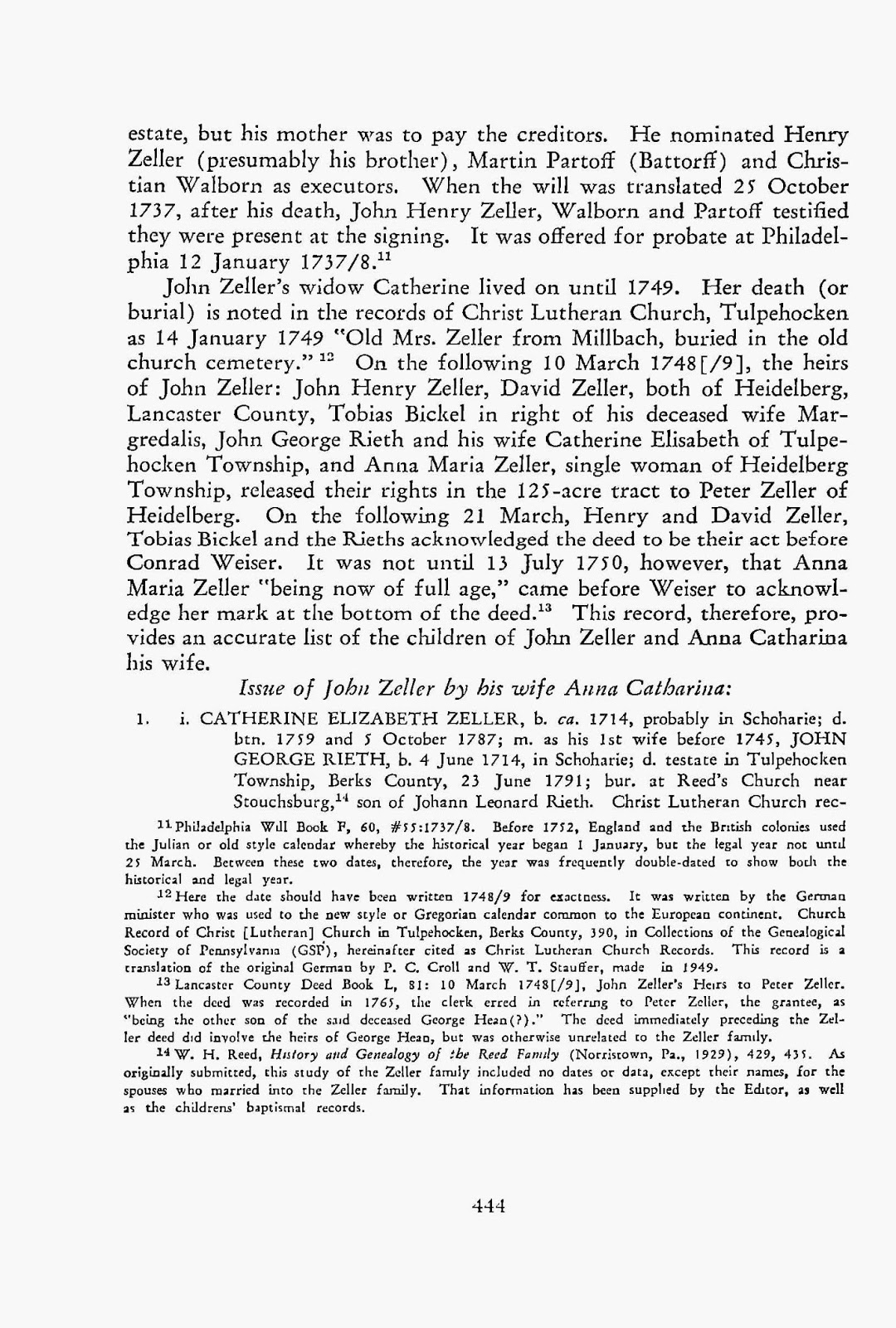
     ANNA CATHRINA ZELLER, born ca. 1722; died after 8 DEC 1771; married by the Rev. Stoever 14 JAN 1743, JOHN PONTIUS, born ca. 1718; died after 1790 in Northumberland (now Union) County.44 He had arrived at Philadelphia on the Ship Glascow, qualifying 9 SEP 1738, aged 20.45 He settled in Tulpehocken Township where in 1768 he was rated on 100 acres of land. He appears to have removed to Buffalo Township, Northumberland County, after 1772, when he was a party to the division of his father-in-law's estate, and before 1778.46 Three children were baptized by Stoever: JOHANN HEINRICH PONTIUS, 1 APR 1744, sponsors Heinrich Zoeller and wife; JOHN PETER PONTIUS, 25 OCT 1747; JOHANNES PONTIUS, 18 AUG 1751. On Whitsunday, 1765, his sons ANDREAS, JOHN PETER, and JOHN NICHOLAS PONTIUS were communicants at Host Reformed Church, and at Christmas, 1769, JOHANNES, JOHN GEORGE, and ANNA MARIA PONTIUS, his sons and daughters, communed at the same Church.


    Millenium File:
    Name: Anna Catherine Zeller
    Gender: Female
    Birth Date: 1722
    Birth Place: Tulpehocken, Berks, Pennsylvania, USA
    Father: Johan Heinrich Zeller
    Mother: Anna Maria PerigalBerigal
    Spouse: John Frederick Pontius
    Children: Mary Elizabeth Pontius


    1745 - Henry built Fort Zeller
    Memorials of the Huguenots in America: shows:
    His house, a massive stone edifice, erected with a view to protect the family and neighbors in case of an attach from the Indians, is still standing." This house, now an historical relic of the section, and known as "Zeller's Indian Fort," was erected in 1745, on the banks of the mill creek and, as stated, was used for a fort. But the author of the paragraph quoted was not quite accurate when he called it a "massive stone edifice." The walls are massive enough, but the building could hardly be called an edifice. He also erected the first meeting place of these early Schohaire settlers for worship, defense and mutual conference.

    1756 - Heinrich Zeller Died

    Find A Grave Entry:
    Name: John Heinrich Zeller
    Birth Date: 1679
    Birth Place: France
    Death Date: 1756
    Death Place: Stouchsburg, Berks County, Pennsylvania, USA
    Cemetery: Tulpehocken Trinity UCC Cemetery
    Burial or Cremation Place: Millardsville, Lebanon County, Pennsylvania, USA
    Has Bio?: Y
    Spouse: Anna Maria Zeller
    Mother: Clothilde Zeller

    Probate:
    Berks County Will Book 1, pp. 13, Will of Heinrich Zeller.

    Name: John Henry Zeller
    Probate Date: 1756
    Probate Place: Berks, Pennsylvania, USA
    Inferred Death Year: Abt 1756
    Inferred Death Place: Pennsylvania, USA

    Item Description: Probate Estate Files, Wert, Christina-Zwerentz, Ludwig, 1752-1799


    The Will Of Johannes Heinrich Zeller
    In the name of God Amen!
    The Third day of August in the year of our Lord one thousand seven hundred and fifty four, I Johan Henrich Zeller of Tulpehoken in the County of Berks yeoman, calling to mind the mortality of my body and knowing that it is appointed for all men once to die, but being yet of Perfect mind and memory fo therefor ordain this my las will and testament, that is to say. Principally & first of all I give and recommend my soul in the hands of God that gave it and for my body.  I recommend it to the earth to be buried in a Christian like and decent manner at the discretion of my herein mentioned executors, nothing doubting but at the general resurrection I shall receive the same again by the mightly hand of God and as touching such worldly state wherewith it hath pleased God to bless me in this life, I give, devise, and dispose of the same in the following manner set for, that is to say - 
    First I give and Bequeath to my son Johan George Zeller, and to his Heirs and asigns for ever my plantation whereon I know live, and all my real and irrevocable estate.  the Dowry due to my loving wide Anna Maria excepted and upon condition that he my said son Johan George Zeller his heirs and assigns, shall pay unto my herein mentioned executors the sum of two hundered and fifty pounds current money of Pennsylvania in manner and form following.  That is toe say forty pounds part thereof for my son Johan Heinrich Zeller Junion.  Within four months after my decease, Item forty pounds for my son Johan David Zeller also within four months after my decease, nevertheless if my son John George will keep and maintain his said brethren during their life time.  they being simple in victuals and drink.  washing and lodging handsomely and to the satisfaction of thier guardian herein mentioned he shall not be obliged to pay any thing for them as long as he keeps them so, and after ?????  the said Johan Heinrichs or Johan Favid decease he my said son Johan George shall be requited for the sum given to them by me as aforesaid and shall never pay them, otherwise if he don't keep them so as aforesaid he shall pay such sums for their use and maintenance and what is left after their decease shall be equally divided among and between all my children or their representative.  The remainder sum of one hundred and seventy pounds shall be equally divided between the rest of my children or their representatives to wit: Hartman Zeller, John Zeller, Anna Maria Saltzgeber, Barbaralis Lerew, Catrina Pontious, and Anna Elisabeth Battorff, and for the payment of the said sum of one hundred and seventy pounds he shall have a years time after my deceased, provided he doed not offer to sell his land herein bequeathed to him, if so then he shall give security for hte payment of the whole sum of two hundred and fifty pounds before mentioned.  As to my moveables I give and bequeath them to my before named loving wife Anna Maria, and what is left after her decease shall be equally divided between my before named nine children or to thier representatives.

    Item, I ordain and nominate my son John Zeller and Leonhard Anspach my son in law executors of this my last will and testament, and I do hereby disallow and revoke all and every other former testaments, wills, legacies and executors by me in any way before this time named, willed, and bequeathed.  Ratifying and confirming this and no other to be my last will and testament.

    In witness whereof I have here unto my hand seal the day and year first above written

    Be it remembered that I do appoint the aforesaid John Zeller and Leonhard Anspach to guardian said sons John Heinrich and John David who being not able to care for themselves because of their simplicity, until an orphans court in this county shall see cause to appoint others.  
                                          

    Burial:

    The Zeller Memorial was placed in by the Zeller Family Association, in Reeds Cemetery.
    https://www.findagrave.com/cemetery/45852/reeds-cemetery


    From the find a grave website - 
    "Reed's Church or Rieth's Church was erected in 1727 about 1/2 mile northeast of Stouchsburg. It was made of roughly hewn logs and reportedly had a tree stump for a pulpit. The church was constructed so that it may be used as a fort in the even of an Indian attack. Supposedly a vault for the storage of ammunition was placed under the earthen floor. While the cemetery remains, the church is no longer there.

    Records of Reed's Cemetery published by the Tulpehocken Settlement Historical Society is extremely helpful in identifying the older tombstones."


    Additional Research:
    ====================================================================
    John Pontius (son in law of Henry Zeller) appears to have removed to Buffalo Township, Northumberland County, after 1772, when he was a party to the division of his father-in-law's estate, and before 1778

    Memorials of the Huguenots in America: shows:
     He died in January, 1756, and his will, made Aug. 3, 1754, was probated Jan. 20, 1756. This will shows a wife, Anna Maria, and children: John George (who obtained the homestead), John Henry, John David, Hartman (The Rev. Mr. Stapleton gives this name as Martin), John, Anna, Maria Saltztius, Barbara (or Barbaralis) Lerew, Catharine Pontius and Anna Elizabeth Battorf. The executors are shown as his son John and son-in-law Leonard Anspach, accordingly there must have been another daughter."

    ..on 3 AUG 1754, he had his Will drawn. He gave the plantation "whereon I now live" and all his moveable estate to his son JOHANN GEORGE ZELLER, he to pay pds. 250 for it to the other heirs. Out of this sum his sons JOHANN HEINRICH and JOHANN DAVID were each to have pds. 40, but JOHANN GEORGE was to care for them, "they being simple." The balance of pds. 170 was to be divided between the rest of his children: HARTMAN ZELLER, JOHN ZELLER, ANNA MARIA SALTZGEBER, BARBARALIS LEREW, CATHARINA PONTIUS and ANNA ELIZABETH BATTORF. He provided for his wife ANNA MARIA, and nominated his son JOHN and son-in-law LEONARD ANSPACH executors.

     The Will was accepted for probate 20 JAN 1756.34 ANNA MARIA ZELLER, widow of JOHANN HEINRICH, is reported to have survived him until 1765, but it was not until 1772 that any disposition of his property was made.

    On 28 DEC of that year JOHN ZELLER of Berks County, ANNA MARIA SALTZGEBER, widow of Lancaster County, JOHN PONTIUS of Berks County in right of his wife ANNA CATHERINE, LEONARD SCHWARTZ of Berks County in right of wife ANNA ELIZABETH, BARBARA LERU of (blank), and HARTMAN ZELLER of Frederick County, Maryland, for consideration of pds. 250 paid by JOHN GEORGE ZELLER, released and quitclaimed their rights in the 245 acres of which JOAHNN HEINRICH ZELLER had died seized.

     Thus from his Will and the quit-claim deed, a list of the children of JOHANN HEINRICH ZELLER can be firmly established. - Genealogies of Pennsylvania Families from the Pennsylvania Genealogical Magazine. Volume III: Stauffer-Zerbe, article entitled "Zeller Family Revision" by John F. Valentine Published in 1977


    +++++++++++++++++++++++++++++++++++++++++++++++++++++++++++++++

    Research:

      Various dates may be confusing because prior to 1752, the English used the Julian calendar and the Germans used the Georgian (Gregorian) calendar. So some dates may be shown as month, day, year/year.  Anna Maria Catharina Zeller's death is sometimes shown as January 14, 1748/1749. That is because under the (old) Julian calendar, the new year did not begin until March 25th. So her death on January 14th was considerd as being in 1748
    under English records.  However, her death date is recorded in church records  as January 14th, 1749, because church records used the Georgian calendar. Today we use the Georgian (Gregorian) calendar.


    JOHANN HEINRICH ZELLER
    Genealogies of Pennsylvania Families from the Pennsylvania Genealogical Magazine. Volume III: Stauffer-Zerbe, article entitled "Zeller Family Revision" by John F. Valentine Published in 1977
    JOHANN HEINRICH ZELLER, reported to have been born in France in 1684, and to have married ANNA MARIA BRIEGAL, daughter of JAMES BRIEGAL (VON BRUEGAL) of Holland,32 came with his family to Pennsylvania from Schoharie probably about the same time as JOHANN ZELLER. Unlike JOHANN, he took up land, not in Heidelberg Township, but in what became Tulpehocken Township in the present Berks County, but was then Lancaster County. On 2 DEC 1738, he purchased from Casper Wister, the Philadelphia brass-button maker, 115 acres a branch of the Swatara Creek in Tulpehocken. Later he took up another 115 acres, adjoining the first tract, which were patented to him 10 OCT 1750.33 Four years later on 3 AUG 1754, he had his Will drawn. He gave the plantation "whereon I now live" and all his moveable estate to his son JOHANN GEORGE ZELLER, he to pay pds. 250 for it to the other heirs. Out of this sum his sons JOHANN HEINRICH and JOHANN DAVID were each to have pds. 40, but JOHANN GEORGE was to care for them, "they being simple." The balance of pds. 170 was to be divided between the rest of his children: HARTMAN ZELLER, JOHN ZELLER, ANNA MARIA SALTZGEBER, BARBARALIS LEREW, CATHARINA PONTIUS and ANNA ELIZABETH BATTORF. He provided for his wife ANNA MARIA, and nominated his son JOHN and son-in-law LEONARD ANSPACH executors. The Will was accepted for probate 20 JAN 1756.34 ANNA MARIA ZELLER, widow of JOHANN HEINRICH, is reported to have survived him until 1765, but it was not until 1772 that any disposition of his property was made. On 28 DEC of that year JOHN ZELLER of Berks County, ANNA MARIA SALTZGEBER, widow of Lancaster County, JOHN PONTIUS of Berks County in right of his wife ANNA CATHERINE, LEONARD SCHWARTZ of Berks County in right of wife ANNA ELIZABETH, BARBARA LERU of (blank), and HARTMAN ZELLER of Frederick County, Maryland, for consideration of pds. 250 paid by JOHN GEORGE ZELLER, released and quitclaimed their rights in the 245 acres of which JOAHNN HEINRICH ZELLER had died seized.35 Thus from his Will and the quit-claim deed, a list of the children of JOHANN HEINRICH ZELLER can be firmly established.

    32 "Huguenot Pioneers," pp. 176, cited in Note 1. Her surname has been spelled in various ways, and it is of interest to note that a Johann George Brigel was a sponsor at a baptism in Schoharie in 1715. See MacWethy, pp. 29, cited in Note 2, "The Kocherthal Records of the West Camp Lutheran Church," and that a J.G. Brugel was a sponsor in 1742 in the records of Host Reformed Church, Tulpehocken Township, Berks County, Book 1, pp. 1 in GSP, hereinafter cited at Host Reformed Church Records. These records are translated of the originals by the late Mrs. C.M. Steinmetz.

     33 Recited in Berks County Deed Book B-2, pp. 84,; 28 DEC 1772, John Zeller and Leonard Anspach to Johann George Zeller. On 6 NOV 1734, one "Henry Seller" obtained a warrant for 200 acres in then Lancaster County, and on 21 DEC 1737, two more warrants for 150 acres each, also in Lancaster County. It has not been established for this record that these were taken out by Johann Heinrich Zeller. Pennsylvania Archives, 3rd Series, XXIV, pp. 519, 521.

    34 Berks County Will Book 1, pp. 13, Will of Heinrich Zeller.
      
    35 Berks County Deed Book B, pp. 88; 28 DEC 1772, John Zeller et als. to John George Zeller. 


    ====================================================================
     Millenium File
    Name: Johan Heinrich Zeller
    Gender: Male
    Birth Date: 1685
    Birth Place: Paris, Seine, France
    Death Date: 1756
    Death Place: Berks., Pennsylvania, USA
    Father: James Jacques Zeller
    Mother: Clothilde De Valois
    Spouse: Anna Maria PerigalBerigal
    Children: John Zeller; Anna Catherine Zeller
    Spouse Father: James PerigalVan Berigal


    The Truckenmiller/Druckenmiller Connection

    My husband Daniel's 6th great grandfather,  Sebastian Truckenmiller,  came to America in 1732.  He married, and had 8 children.  My husb...